

TL;DR:
- A campaign timeline template maps every task, milestone, and owner across an influencer marketing campaign. It ensures teams follow deadlines, maintain coherence, and avoid delays during all four key phases. Using fixed points, clear ownership, and strict review gates improves campaign execution and results.
A campaign timeline template is a scheduling and coordination tool that maps every task, milestone, and owner across an influencer marketing campaign from strategy through post-launch measurement. Without one, teams miss approval windows, creators post out of sequence, and launch day becomes damage control. Marketing professionals in Singapore running multi-creator campaigns face this risk acutely, especially when managing across time zones and platform-specific content windows. Contentgenz centralizes this workflow so brands can track deliverables, approvals, and payments in one place. The four-phase structure covered here applies whether you are running a single product drop or a 16-week brand campaign.
What are the essential phases of a campaign timeline template?

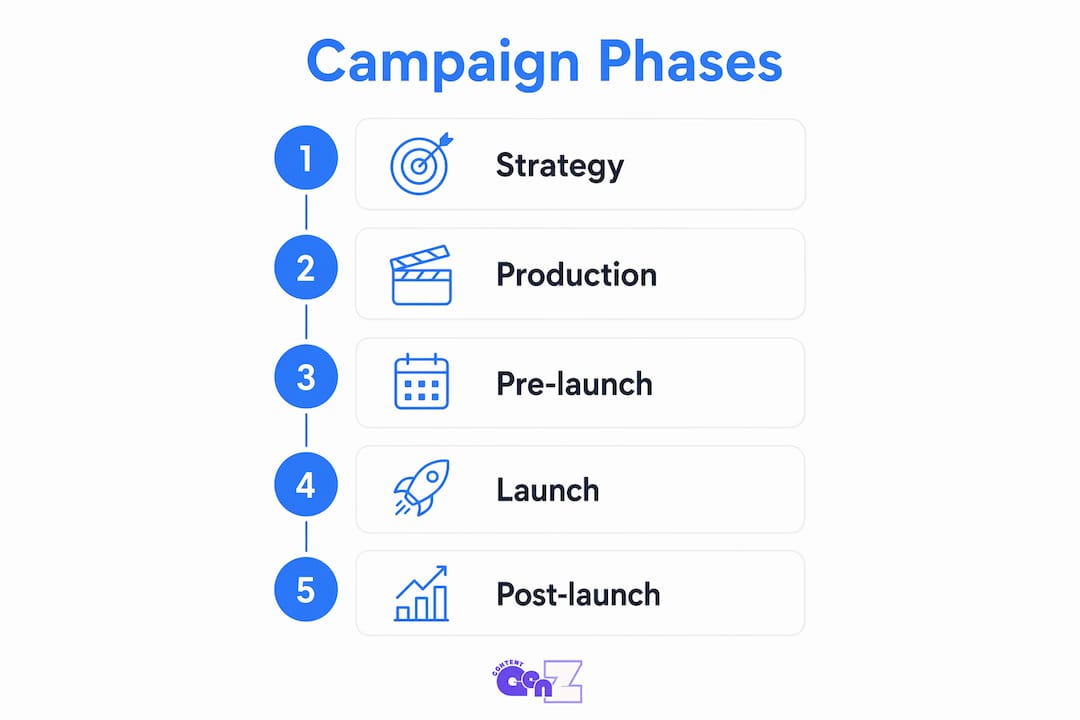
A well-built campaign timeline template follows four distinct phases: Strategy and Positioning, Creative Production, Pre-launch Activation, and Launch plus Post-launch Measurement. Each phase has defined deliverables and a gating milestone that must be approved before the next phase begins. Skipping gates is the fastest way to produce content that misses the brief.
The table below summarizes each phase with its typical duration, core objective, and key deliverables.
| Phase | Weeks | Objective | Key Deliverables |
|---|---|---|---|
| Strategy and Positioning | 1–3 | Define audience, messaging, and creator fit | Positioning brief, messaging hierarchy, creator shortlist |
| Creative Production | 4–7 | Develop and approve all content assets | Scripts, visual assets, influencer content drafts |
| Pre-launch Activation | 8–11 | Seed product, brief media, activate PR | Influencer seeding, press outreach, teaser content |
| Launch and Measurement | 12–16 | Execute launch and track performance | Live posts, paid social, day 3/7/14 performance reports |
The Strategy and Positioning phase sets the foundation. The deliverables here include a positioning brief that locks in the campaign's core claim and a messaging hierarchy that every creator references. Skipping this step means each creator interprets the brief differently, and the campaign loses coherence across channels.
Creative Production runs weeks 4 through 7 and is where most timelines slip. Scripts, visual assets, and influencer content drafts all require review cycles. PR and press outreach should start 4–6 weeks before launch, which means the Pre-launch Activation phase must begin no later than week 8. If your campaign involves media exclusives, outreach starts at week 1. That overlap between production and pre-launch is intentional and must be built into the template explicitly.
Pro Tip: Build a formal gate at the end of each phase. No team moves forward until the phase deliverable receives written sign-off. This single rule eliminates the most common cause of mid-campaign chaos.
How to customize your campaign schedule template for influencer marketing
Customizing a marketing plan timeline starts with identifying your fixed points. Fixed points are immovable dates like Singapore's Harborfront product launch windows, 9.9 and 11.11 sales events, or industry trade shows. Every other task sequences backward from those anchors. Planning around fixed dates improves audience engagement because your campaign reaches people when they are already in a buying mindset.
Once fixed points are set, assign a single owner to every task. Single task ownership clarifies responsibility and drives progress. When two people share ownership of a deliverable, neither feels fully accountable. The result is missed deadlines and finger-pointing during post-mortems.
Choosing the right format for your timeline
The format you choose shapes how your team interacts with the schedule daily.
- Spreadsheet timelines work well for small teams managing fewer than five creators. They are easy to share and require no software license, but they break down when dependencies become complex.
- Gantt charts visualize task dependencies clearly and show how a delay in one task pushes everything downstream. Tools like Google Sheets with a Gantt add-on or dedicated project management platforms handle this well.
- Project management platforms with task-level tracking suit campaigns with ten or more creators, multiple approval layers, and cross-functional teams. They support automated reminders and dependency mapping.
One distinction that most teams miss: a marketing calendar differs from an operational timeline. A marketing calendar shows go-live dates at a summary level. An operational timeline details tasks, owners, dependencies, and revision cycles. Merging both into one spreadsheet creates complexity and confuses stakeholders. Keep them separate and link them by reference.
Pro Tip: Break every large campaign deliverable into subtasks of no more than two days' work. If a task takes longer than two days to complete, it is not specific enough and will slip without anyone noticing until it is too late.
Best practices for timeline customization
- Map every dependency before assigning deadlines. If the paid social brief depends on the final creative, the brief cannot be due before the creative is approved.
- Set buffer time between the end of Creative Production and the start of Pre-launch Activation. A minimum of three business days handles unexpected revision requests.
- Use color coding to distinguish phases, owners, and status. Visual clarity reduces the number of status update meetings your team needs.
- Document the template version and date every time you revise it. Campaigns that run across multiple weeks often have team members working from outdated versions.
What are common challenges in managing influencer campaign timelines?
Stakeholder feedback is the top cause of timeline slippage in influencer marketing campaigns. Delayed client feedback extends project timelines unless review windows are formally built into the schedule. The fix is not to ask stakeholders to respond faster. The fix is to schedule their review time as a task with a deadline, just like any other deliverable.
"Feedback creep" is the related problem. It happens when unlimited revision rounds are implied rather than contracted. Experienced project managers cap creative deliverables at two formal revision rounds. Beyond two rounds, the campaign loses time it cannot recover, and the creative quality rarely improves proportionally.
Implementing fixed review gates with strict turnaround deadlines for stakeholder feedback reduces the risk of scope creep and timeline extension. When every stakeholder knows their review window closes in three business days, they prioritize the feedback. When the window is open-ended, the review drifts to the bottom of their inbox.
Unclear dependencies cause a different category of delay. When a team member does not know that their task is blocking three others, they treat it as low priority. Mapping dependencies visually, whether in a Gantt chart or a simple dependency column in a spreadsheet, makes the cost of delay visible to everyone.
Steps to prevent and manage timeline delays
- List every dependency before the campaign starts. Identify which tasks cannot begin until another is complete and document them explicitly in the timeline.
- Assign formal review windows. Build 3–5 business days for client reviews into the schedule as named tasks with owners and due dates.
- Cap revision rounds at two. State this in the campaign brief and the creator agreement before production begins.
- Communicate delays immediately. When a task slips, notify all downstream owners the same day. Give them a revised date, not a vague "soon."
- Run a weekly timeline check-in. A 15-minute sync every Monday catches slippage before it compounds. Review the current week's tasks, confirm ownership, and flag any blocked items.
How to execute and optimize your campaign using the timeline
Launch week runs on a daily cadence. Coordinated influencer posting, paid social ad activation, and real-time performance monitoring all happen in parallel. Assigning a named team member to each channel on day one prevents the confusion that comes from everyone watching the same dashboard and no one acting on what they see.
The table below separates launch week activities from post-launch tasks so your team knows exactly what shifts after day seven.
| Activity | Launch Week (Days 1–7) | Post-launch (Days 8–30) |
|---|---|---|
| Influencer content | Coordinated posting per schedule | Repurpose top-performing content |
| Paid social | Activate ads aligned to influencer posts | Kill underperformers, scale winners |
| Performance monitoring | Real-time dashboard, daily team check-in | Day 3, 7, and 14 formal reviews |
| Stakeholder reporting | Daily summary to brand team | Weekly report with trend analysis |
| Creative adjustments | Minor copy tweaks only | Test new hooks based on data |
Post-launch measurement follows a structured cadence. Day 3, 7, and 14 performance reviews identify which ads to cut and which to scale. Day 3 catches early signal on creative resonance. Day 7 confirms whether the audience segment is converting. Day 14 gives enough data to make budget reallocation decisions with confidence.
Documenting results is the step most teams skip. Recording campaign metrics like customer acquisition cost, top-converting audience segments, and best-performing creative hooks turns a single campaign into institutional knowledge. The next campaign starts from a higher baseline instead of repeating the same discovery process. This is how brands in Singapore build compounding returns from influencer marketing over time.
Key Takeaways
A campaign timeline template with defined phases, single task ownership, and fixed review gates is the most reliable way to execute influencer marketing campaigns without delays or missed milestones.
| Point | Details |
|---|---|
| Four-phase structure | Divide campaigns into Strategy, Production, Pre-launch, and Launch phases with gating milestones between each. |
| Fixed points first | Anchor your timeline to immovable dates like sales events before sequencing any other tasks. |
| Single task ownership | Assign one owner per task to eliminate ambiguity and drive accountability across the team. |
| Cap revision rounds | Limit creative revisions to two formal rounds to prevent feedback creep and timeline overruns. |
| Post-launch cadence | Run formal performance reviews at day 3, 7, and 14 to make data-driven optimization decisions. |
Why timeline discipline separates good campaigns from great ones
I have managed influencer campaigns across categories ranging from food and beverage launches to consumer tech drops in Singapore. The single biggest predictor of a smooth launch is not budget or creator count. It is whether the team built the timeline before the brief went out, or after.
When the timeline comes first, every decision that follows has a constraint. The creator brief is due by a specific date because production starts on a specific date. The PR outreach goes out early because the timeline shows exactly how many weeks of lead time the media needs. When the timeline comes after, the team is always catching up.
The revision cap is the rule I have seen teams resist most. Clients feel that two rounds is not enough. In practice, two rounds with clear feedback consolidation produces better creative than five rounds of scattered comments. The discipline forces stakeholders to prioritize their feedback rather than drip it in over two weeks.
The other habit that separates high-performing teams is post-campaign documentation. Most teams debrief verbally and move on. The teams that build compounding campaign performance write down what worked, what the top-converting audience segments were, and what creative hooks drove the most conversions. That document becomes the starting brief for the next campaign.
Treat your campaign timeline template as a living document. Update it when resources change, when a creator drops out, or when performance data suggests a channel shift. A static timeline is a plan. A dynamic one is a management tool.
— Elliot
How Contentgenz helps you manage campaign timelines
Running a 16-week influencer campaign across multiple creators and approval layers without a centralized system means critical tasks fall through the gaps. Contentgenz gives marketing professionals and project managers a single workspace to manage the full influencer campaign workflow, from creator sourcing and briefs through approvals and payments.
Contentgenz tracks deliverables, assigns task ownership, and keeps every approval on record so your team always knows what is pending and what is cleared. Brands pay no platform fees, and creators receive 100% of their earnings, which makes the model work for campaigns of any size. If you are planning your next influencer campaign in Singapore, the Contentgenz platform is built to keep your timeline on track from day one.
FAQ
What is a campaign timeline template?
A campaign timeline template is a scheduling document that maps every task, milestone, owner, and deadline across a marketing campaign. It covers phases from strategy through post-launch measurement to keep teams aligned and on schedule.
How long should an influencer marketing campaign timeline be?
A full influencer marketing campaign typically runs 12–16 weeks, covering strategy, creative production, pre-launch activation, and post-launch measurement. Shorter campaigns of 6 weeks are possible for agency-led product launches with tighter scopes.
How do I avoid delays in my campaign timeline?
Build formal review windows of 3–5 business days for stakeholder feedback, cap creative revisions at two rounds, and map all task dependencies before the campaign starts. These three practices eliminate the most common causes of timeline slippage.
What is the difference between a marketing calendar and a campaign timeline?
A marketing calendar shows go-live dates at a summary level, while an operational campaign timeline details tasks, owners, dependencies, and revision cycles. Merging both into one document creates stakeholder confusion and should be avoided.
When should PR outreach start in a campaign timeline?
PR and press outreach should begin 4–6 weeks before launch. If the campaign involves media exclusives, outreach starts at week one of the campaign timeline to give journalists enough lead time.